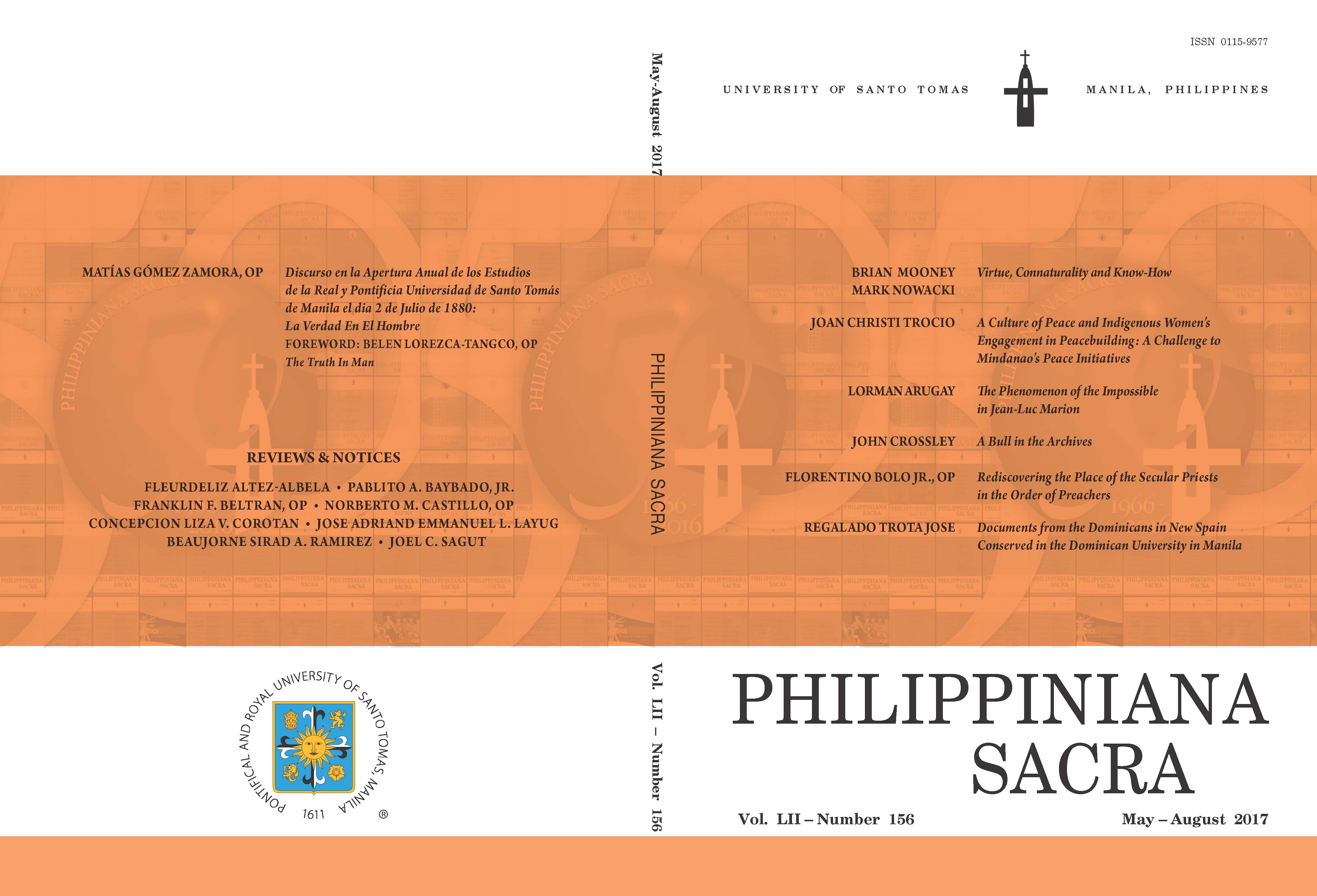
-
DOI :
-
https://doi.org/10.55997/ps2001lii156a1
-
Author/s :
-
Thomas Brian Mooney / Charles Darwin University, Darwin, Australia;
Mark Nowacki / School of Social Sciences, Singapore Management University, Singapore
Abstract :
In this paper, we sketch a metaphysics of natural purposes that supports the claim that there are objective goods that beings need qua the kinds of being they are in order to flourish. We argue that flourishing includes the acquisition of virtues. We give a general account of virtue, roughly as a stable disposition to act upon a habit elevated to a skill of putting one's know-how into practice that springs from one's motivation to pursue what one perceives as good. We then provide a sketch of intellectual virtues as truth-seeking virtues that stem from a love of the truth. We discuss connaturality, namely those specific metaphysical accidents readily acquired by beings due to their first nature. We make an original distinction between ontological connaturality, namely the connaturality that belongs to animals qua beings of a certain kind, and habitual connaturality, namely our first natures suffused with virtues. Habitual connaturality is acquired through the practice of virtue and involves perceptiveness awakened by the possession of the virtue in question. The knowledge arising from this form of connaturality may be a form of know-how. We give an account of connatural apprehension and connatural propositional knowledge and discuss connatural know-how and argue that it makes certain virtues possible. At this point we will have shown that intellectual and moral virtues are informed by know-how. We go on to give analyses of know-how and skill in terms of counterfactual success. We show how skill is a refined form of know-how and how both know-how and skill are informed by moral and intellectual virtues. We conclude that know-how informs intellectual and moral virtues in the sense that virtue is to be elucidated in terms of skill, which is in turn to be elucidated in terms of know-how. Moreover, virtues inform know-how in the sense that know-how is to be elucidated in terms of intellectual and moral virtues. No circularity arises because different virtues and different forms of know-how are involved.
Keywords : Aquinas, Metaphysics, Epistemology, Connaturality, Virtue, Intellectual Virtues, Know-How, Skills, Flourishing
-
DOI :
-
https://doi.org/10.55997/ps2002lii156a2
-
Author/s :
-
Joan Christi Trocio / Institute of Religion, University of Santo Tomas, Manila, Philippines
Abstract :
In the context of Mindanao, an island beset with war and conflict, peace building efforts have been raised to a certain level of intensity. With the hopes to avoid war and conflict, initiatives toward achieving peace have been documented, but mostly, those which are wanting of stories involving women in the peace building processes. This paper attempts to expose stories of women's engagement in peace building which may provide insights and post challenges to future peace initiatives involving women, especially the Lumad women. The term lumad collectively refers to the cultural communities in Mindanao. Women are naturally presented as resilient and soft-natured. These characteristics can be seen in a woman at home and in the community. Some cases are presented in this paper which highlight the foregoing attributes of women that enable them to stand out amidst war and conflict.
Keywords : Peace, Women, Indigenous Peoples
-
DOI :
-
https://doi.org/10.55997/ps2003lii156a3
-
Author/s :
-
Lorman Arugay / Faculty of Philosophy, University of Santo Tomas, Manila, Philippines
Abstract :
In a world where philosophical thinking and thinking in general have become more and more manipulative in an ever escalating manner, Jean-Luc Marion pledges us back into that originary philosophical disposition of wonder before the insurmountable. In place of a "limiting modern metaphysics" that confines any appearing within the lifeless realm of intellectual certainty and logical precision, the philosopher sketches for us the possibility of an appearing beyond the clutches of Being. Marion's new phenomenology thus births a possibility of accommodating revelation, back into philosophical discourse. His philosophy is an outlining of the possibility of what is rendered conceptually impossible by modern "conditions of possibility" - God.
For any philosophy of religion to thrive, he says, it must be able to provide intelligibility in what religion reports. Hence, Marion's new phenomenology is a sketching of the philosophical possibility of revelation itself. This paper is a critical exposition of the heart of Marion's thought: the saturated phenomenon - the site where the ineffable can in fact present itself without restriction. In order to facilitate understanding, the paper also traces the trajectory of Marion's thought. From his critique over the intellectual provincialism of the moderns, (which shut the doors for the revelatory character of truth) to the failed attempts of Kant, Husserl, and Heidegger to render a phenomenon worthy of the name. Until at last, we arrive at Marion's proposal of the saturated phenomenon -the center of a breakthrough that forever changed the face of phenomenology.
Keywords : Jean-Luc Marion, Phenomenology, Overcoming Metaphysics, Descartes, Kant, Husserl, Heidegger
-
DOI :
-
https://doi.org/10.55997/ps2004lii156a4
-
Author/s :
-
John N. Crossley / Monash University, Melbourne, Australia
Abstract :
Another treasure has been brought to light from the Archives of the University of Tomas. It is a personal copy of the papal bull given to knights of the Order of Santiago, the foremost Spanish knightly order. It belonged to G?mez P?rez Dasmari?as, governor of the Philippines from 1589?1593. The Order spanned both religious and military life, and is an indication of the high respect in which G?mez P?rez was held in Spain. However, it stresses the Spanish hatred of the Muslims (or Moors) and thereby sheds light on the origins of the divisions between Muslims and Christians in the Philippines that have plagued the islands for more than five centuries.
Keywords : Order of Santiago, Papal bull, G?mez P?rez Dasmari?as
-
DOI :
-
https://doi.org/10.55997/ps2005lii156a5
-
Author/s :
-
Florentino Bolo Jr., OP / Faculty of Canon Law, University of Santo Tomas, Manila, Philippines
Abstract :
When the Order of Preachers, in response to the renewal called for by the Second Vatican Council, legislated on the use of the term Lay Fraternities in place of Third Order, the status of its priest-tertiaries was inevitably placed in an ambiguous situation. Even if the Order later on rectified the oversight by creating a separate Rule of life for the priests, there ensued decades of stagnant, if not almost oblivious, existence of the secular priests in the consciousness of both the friars and of the different branches of the Dominican Family.
This study centers on the recovery of the nature and identity of the Priestly Fraternities of St. Dominic, which entailed the establishment of continuity in two levels of legislation, namely, that of the Church through the Code of Canon Law, and that of the Dominican Order through its various legislative organs. Thus, the continuity established by both historical and canonical elements substantiated the official status of the fraternities as third order, as such enjoying a certain level of juridical relationship with the Order of Preachers.
With such findings, the secular priests are acknowledged with greater level of awareness, not only in their unique place in the structure of the Order, but also in their capacity to offer to the Dominican Family a distinct manner of collaborative action in the context of the diocesan ministry.
Keywords : Third Order, Priestly Fraternities of St. Dominic, Dominican Family, Code of Canon Law, Second Vatican Council, Order of Preachers, Lay Fraternities